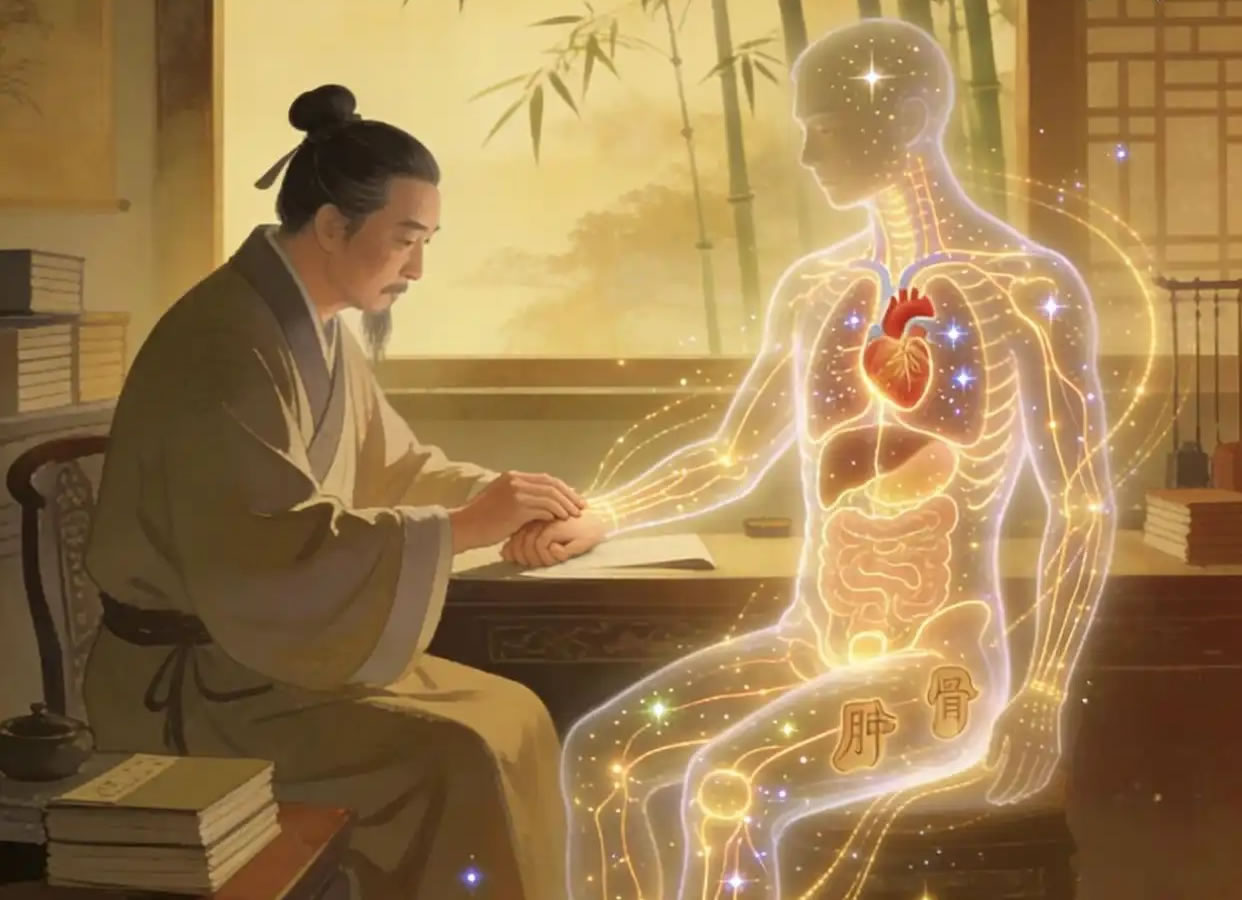
Many people’s first impression of TCM is: “The doctor holds my wrist, closes his eyes and thinks for a while. Then he tells me things I never told him. Wow — so magical.”
It’s not actually magic. Pulse diagnosis is a skill. Like reading a map.
Why can that blood vessel on your wrist tell a doctor so much? Because every time your heart beats, it pumps blood through your whole body. As blood flows past different organs — your liver, lungs, kidneys, stomach — each organ’s condition subtly changes the shape of your pulse.
An experienced doctor pressing on your pulse with their fingers can feel at least five things:
Speed. A normal heart rate is 60-100 beats per minute. Too fast could mean heat. Too slow could mean cold.
Strength. Is your pulse strong or weak? Strong means your body is reacting intensely. Weak means your qi and blood are low.
Depth. Can the doctor feel it with a light touch? That’s called “floating” — the problem might be near the surface. Does the doctor have to press deep to feel it? That’s “sinking” — the problem might be deeper inside.
Width. Is your pulse thin like a thread or thick like a rope? Too thin means low qi and blood. Too thick and hard could mean blockage.
Rhythm. Is it regular? If it speeds up, slows down, or skips beats — that needs attention.
You don’t need to learn how to take a pulse. But here’s what you should know: that minute when the doctor holds your wrist, they’re not performing a ritual. They’re collecting information. Like a mechanic using a tool to read your car’s engine data.
The only difference is, the “tool” is their fingers, and the “data” comes from your body.